...is something Miriam Toews refers to when she talks about a novel's structure. The novel's typical connective tissue is what she tried to do without when she wrote A Complicated Kindness. I read this in a feature on her and I heard it straight from her mouth at her session earlier this month at Talking Fresh in Regina. As I listened to her speak I recalled images of connective tissue. I wondered what would remain without this tissue. Would the remaining fragments have shape or would the reader be lost in their shapelessness? I was already part-way through A Complicated Kindness by that time, and I already knew the novel held together, that it had inherent shape (as mentioned in the discussion) even though she had dispensed with the usual conventions. I finished reading it earlier today and I've been thinking about it and her comments on connective tissue ever since. Even though Toews does without the obvious fibrous connective tissue, a plot for example, there is great resonance. It pulses through the novel, oxygenating the fragments. It, like blood, is connective tissue.
It's an excellent novel.
Thursday, March 31, 2005

Wednesday, March 30, 2005
A 350-year-old play premieres in Calgary
...on April 7. According to this story, the anonymous manuscript, dating back to around 1640, was discovered among items the University of Calgary purchased from the Toronto Public Library in 1971.
Tuesday, March 29, 2005
A still -- Volcano -- Life --
...this poem by Emily Dickinson appears in the introduction of Kamilla Denman's essay "Emily Dickinson's Volcanic Punctuation", which I found tonight after watching a PBS docudrama on the 1883 eruption of the volcano Krakatoa and the resulting tsunami.
In the essay Denman says "to look at Dickinson's punctuation purely as a disruption of language, then, is to miss this musical dimension, where the semantic and rhythmic disruptions are smoothed through an implied melody". An implied melody. I like that. Hmm --
In the essay Denman says "to look at Dickinson's punctuation purely as a disruption of language, then, is to miss this musical dimension, where the semantic and rhythmic disruptions are smoothed through an implied melody". An implied melody. I like that. Hmm --
Monday, March 28, 2005
100 Years of Saskatchewan Art
...is showing at the Mendel Art Gallery. In another story on this show, curator Alexandra Badzak says that Saskatchewan has more artists per capita than anywhere else in Canada. When Badzak speaks of "the province's rich artistic traditions" she is speaking to one of the main reasons why I live here.
Dante's hell and toilet paper
...forever stuck to your foot are much the same, this from the mind of choreographer Paul Taylor.
Sunday, March 27, 2005
I love the arms and armor
...online at the Metropolitan Museum of Art. The collection highlights include the armor of Emperor Ferdinand I. He must have looked a lot like the tin man from the The Wizard of Oz. The armor for Henry II of France is much more to my liking.
It has long been one of my dreams to slip into a suit of armor and walk around in it, or at least attempt a few steps, providing I know nothing of the fate of the ones who wore it in battle. Mind you, I'd surely invent a story, so knowing a version of the armor's history probably wouldn't hurt. I've often wondered what my breathing would sound like in one of those helmets, if it would quicken. Each breath would hammer the metal, the same place a soldier's breath once hit, and bounce right back. The humidity, the resulting moisture on my face would surely get to me, to my imagination.
Henry Wadsworth Longfellow wrote "The Skeleton in Armor" after seeing what else but a freshly unearthed skeleton in armor. The notes that follow this poem say the body was buried in a sitting position. The skeleton in armor was just sitting there - buried, but sitting - wearing a brass breastplate and a quiver of brass arrows as everything kept wearing away.
It has long been one of my dreams to slip into a suit of armor and walk around in it, or at least attempt a few steps, providing I know nothing of the fate of the ones who wore it in battle. Mind you, I'd surely invent a story, so knowing a version of the armor's history probably wouldn't hurt. I've often wondered what my breathing would sound like in one of those helmets, if it would quicken. Each breath would hammer the metal, the same place a soldier's breath once hit, and bounce right back. The humidity, the resulting moisture on my face would surely get to me, to my imagination.
Henry Wadsworth Longfellow wrote "The Skeleton in Armor" after seeing what else but a freshly unearthed skeleton in armor. The notes that follow this poem say the body was buried in a sitting position. The skeleton in armor was just sitting there - buried, but sitting - wearing a brass breastplate and a quiver of brass arrows as everything kept wearing away.
Saturday, March 26, 2005
Path of Promise:
...The Tibetan Nuns Project is a photography exhibit by Jeffrey Davis, showing in Edmonton. Here are some photos from the project.
Friday, March 25, 2005
The Garden of Light
...the third part of a retrospective on the Regina Five, a group of painters who received international attention in the 1960s, is showing at the MacKenzie Art Gallery. I hope to see it in May.
Thursday, March 24, 2005
To celebrate the full moon
...I read "Full Moon and Little Frieda" by Ted Hughes.
Then I looked at Vincent van Gogh's Moonrise. The accompanying story makes me wonder if researchers could pin down places and times in my current manuscript. If they included an astronomer and a botanist, I'd be in trouble. Or maybe not. Because of this story I imagine I'll spend the next year making sure my poem's world properly mimics the more measurable world.
Here's the next full moon day.
Then I looked at Vincent van Gogh's Moonrise. The accompanying story makes me wonder if researchers could pin down places and times in my current manuscript. If they included an astronomer and a botanist, I'd be in trouble. Or maybe not. Because of this story I imagine I'll spend the next year making sure my poem's world properly mimics the more measurable world.
Here's the next full moon day.
Wednesday, March 23, 2005
This startling painting
...of poet Anna Akhmatova has been on my mind ever since I opened the email containing it yesterday. A thoughtful poet sent the webpage to me. I'm not familiar with Akhmatova's work or the Acmeist movement of which she was part. However, going by the brief biographies I've read, I think the painter captured the power of this influential poet not only in the posture and expression, but in the space around her. While she is wearing the most intense blues, bright yellows surround Akhmatova as if she is shedding light on the otherwise blue environment. The portrait is really a biography in itself.
Tuesday, March 22, 2005
I'm thrilled
...to be among the Featured Alumni on The Sage Hill Writing Experience website. After hearing nothing but great things about Sage Hill, I took a large manuscript to the 2003 Fall Poetry Colloquium, hoping for some direction. I got my money's-worth and more. It was one of the best investments I've ever made.
Monday, March 21, 2005
Gloomy moping
...is the least surprising thing I found in poem 267 by Michelangelo, as translated by John Frederick Nims. For some reason I half expected all Michelangelo's poems to be much like these from Michelangelo Love Sonnets and Madrigals, translations by Michael Sullivan. I wonder if little bits of poem 267 were already running through his head when he painted the ceiling of the Sistine Chapel?
Sunday, March 20, 2005
The lomographs
... in Judith Rudakoff's photo essay, "Lomo Sapiens: Do you see what I see?" at Dooney's Cafe, are incredibly stimulating. The more I stare at the images, the more they seem to move, to vibrate, not only from left to right, but from foreground to background, resulting in an inability to locate a stable centre of interest or a solid sense of composition. The experience is quite unsettling. I thought at first I was overreacting, but I tried to draw the images from memory after looking at them, attempting only to capture the major shapes (a task I normally find quite easy), and found the results to be wanting, yet oddly generative.
I just checked out The Lomographic Society International website. Both the site's events page and Rudakoff's essay speak of a lomographic movement, a movement that is happening right now. Literary and visual art movements have been on my mind of late. Maybe I should price out a LOMO Kompakt Automat camera.
I just checked out The Lomographic Society International website. Both the site's events page and Rudakoff's essay speak of a lomographic movement, a movement that is happening right now. Literary and visual art movements have been on my mind of late. Maybe I should price out a LOMO Kompakt Automat camera.
Saturday, March 19, 2005
La Mano Izquierda Impresora
...or Left Hand Press, a chapbook press located in Victoria, launched their website recently. I'm quite taken with the covers. I just ordered Fred Wah's Isadora Blue and Bren Simmer's Fire Lookout. I'm very familiar with the work of Wah and Simmers. I look forward to seeing these titles.
Friday, March 18, 2005
The Imagist Movement and Prufrock
...have occupied my evening, my search stemming from this Salt and Ice post, and in my reading I happened upon a familiar refrain. Ian Johnston, in his lecture on T. S. Eliot's "The Love Song of J. Alfred Prufrock" and The Waste Land, says "I can remember from my childhood BBC radio reports on funding to the arts in which hostile critics quoted a chunk of "Prufrock" ("I grow old . . . I grow old . . ./ I shall wear the bottom of my trousers rolled") as examples of the idiocy of governmental support for the arts".
Thursday, March 17, 2005
Sleep the dream of apples
...this comes from "Gacela of Dark Death", a poem by the Spanish poet Federico García Lorca, as translated by Michelle Cliff. Here is Robert Bly's translation.
There's a good conversation
...on "the relationship between the poem on the page and the poem in performance" going on in the Comments over at Salt and Ice.
Wednesday, March 16, 2005
Forever suspended along the liquid boundary
...that, according to Elisabeth Bronfen, is where Ophelia lies in this painting by John Everett Millais. A poet sent me this link a short while ago. Oddly enough, I recently ran across The Somnambulist, another painting by Millais, during a search after another poet I know spoke of somnambulism. It's as if Millais is a thread and these poets, catching light like Ophelia's blouse, are embroidering my life.
Tuesday, March 15, 2005
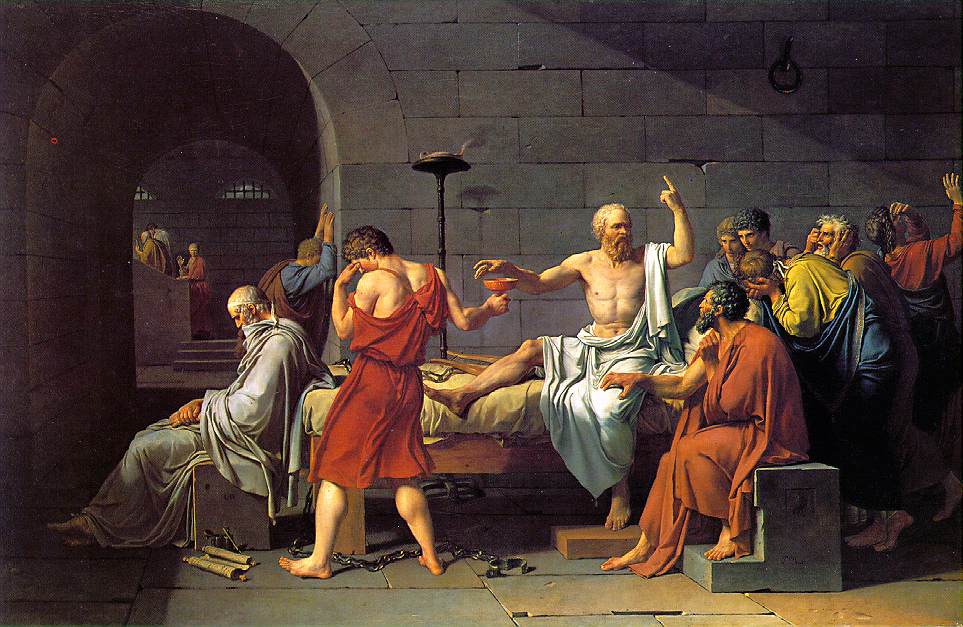
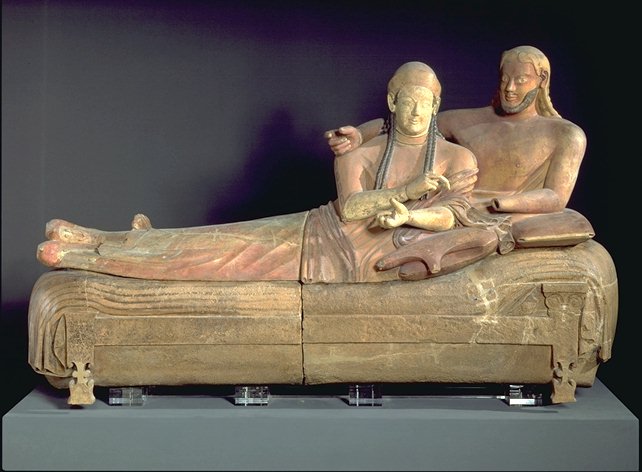
The Death of Socrates
...an oil painted in 1787 by Jacques Louis David and this Etruscan sarcophagus in the Louvre are the two works of art Seamus Heaney, in his tribute to Czeslaw Milosz, says "have about them a typically Miloszian combination of solidity and spiritual force". I remember reading the tribute back in September, but I hadn't looked at the work until now. From now on I imagine these two images will come to mind every time I read Milosz's work.
Monday, March 14, 2005
Ars Poetica?
This poem, written by Czeslaw Milosz in 1968 and translated by Lillian Vallee and himself, is on page 240-41 of Czeslaw Milosz: New and Collected Poems, 1931-2001, a 776 page book I bought on the weekend. Though twenty translators brought these poems to English, Czeslaw Milosz and Robert Hass translated the majority.
I was pointed to the work of Robert Hass a few years ago. I have two of his poetry collections, Human Wishes (the prose poems in Human Wishes never fail to stir me; every time my mind swirls in their tone) and Sun Under Wood, as well as Twentieth Century Pleasures, his essays on poetry, all three listing the six or seven books by Milosz that he has translated. Why, then, has it taken me so long to buy a Milosz book?
Back to Ars Poetica? I mention this poem in particular because I just listened to John MacKenzie read it. Then I read his thoughts on it. Needless to say, I'm now thinking about it.
I was pointed to the work of Robert Hass a few years ago. I have two of his poetry collections, Human Wishes (the prose poems in Human Wishes never fail to stir me; every time my mind swirls in their tone) and Sun Under Wood, as well as Twentieth Century Pleasures, his essays on poetry, all three listing the six or seven books by Milosz that he has translated. Why, then, has it taken me so long to buy a Milosz book?
Back to Ars Poetica? I mention this poem in particular because I just listened to John MacKenzie read it. Then I read his thoughts on it. Needless to say, I'm now thinking about it.
Sunday, March 13, 2005
My spring pilgrimage
...to Talking Fresh in Regina, Saskatchewan was wonderful. It's an eight hour drive one way, but it's more than worth it. Di Brandt, Steven Ross Smith and Miriam Toews gave great presentations, one and all. This year's theme was "writing and community". I spent the entire weekend immersed in the writing community, laughing as we volleyed thoughts and opinions, then laughing some more. Great fun.
A few things:
On the Canadian Association of Physicists’ website there's a new poem by Di Brandt from Welding and Other Joining Procedures. In this series of poems--some of which I was lucky enough to hear in her workshop yesterday--Brandt addresses the "huge gap between sciences and the humanities".
If you ever get the chance to see Po' Girl, do. A fantastic band overall, but my my, the fiddle was mesmerizing. The band is off to West Africa shortly.
And last but never least, I must mention my book purchases. Note: I already own books by the presenters, so that's why none are listed. Ok...
The Possible Past by Aislinn Hunter (see the praise given to it on Salt and Ice).
Czeslaw Milosz: New and Collected Poems, 1931-2001.
Wislawa Szymborska: Poems New and Collected, 1957-1997.
A few things:
On the Canadian Association of Physicists’ website there's a new poem by Di Brandt from Welding and Other Joining Procedures. In this series of poems--some of which I was lucky enough to hear in her workshop yesterday--Brandt addresses the "huge gap between sciences and the humanities".
If you ever get the chance to see Po' Girl, do. A fantastic band overall, but my my, the fiddle was mesmerizing. The band is off to West Africa shortly.
And last but never least, I must mention my book purchases. Note: I already own books by the presenters, so that's why none are listed. Ok...
The Possible Past by Aislinn Hunter (see the praise given to it on Salt and Ice).
Czeslaw Milosz: New and Collected Poems, 1931-2001.
Wislawa Szymborska: Poems New and Collected, 1957-1997.
Thursday, March 10, 2005
I failed
...to get this book read. The only reading time I've had lately is on the bike in the morning. What I've read of it so far has been excellent. Clean prose. Crisp humour. A sharp eye. I wanted to finish reading it before attending this writing festival in Regina where Toews will be presenting.
Wednesday, March 09, 2005
I found The Eye of Silence
...an oil by Max Ernst as I was poking around today. Below the image is Evan M. Maurer's essay about Ernst and the painting, in which he discusses Ernst's "process of deliberate ambiguity". Deliberate ambiguity. That, like the painting, appeals to me.
However, a subsequent search reminded me of its downside. Search results pointed to various nations and their current policies of deliberate ambiguity, nuclear weapons often being mentioned on the same line.
What I find most sobering is that The Eye of Silence, a painting that came to be through a process of deliberate ambiguity, was painted in 1943-44 and, according to Maurer, it's one of the "documents of the artist's traumas during World War II".
However, a subsequent search reminded me of its downside. Search results pointed to various nations and their current policies of deliberate ambiguity, nuclear weapons often being mentioned on the same line.
What I find most sobering is that The Eye of Silence, a painting that came to be through a process of deliberate ambiguity, was painted in 1943-44 and, according to Maurer, it's one of the "documents of the artist's traumas during World War II".
Tuesday, March 08, 2005
The constructive features of silence
...have occupied my thoughts ever since I came across those words in ""Moncton Did You Know?" Northrop Frye's Early Years", an essay by Robert D. Denham in the Antigonish Review #138. Naturally such thinking led to a consideration of the destructive features. Then a face of features. Before I knew it silence was practically smiling.
This essay is the first I've read about Frye's life and it's the first I've heard about his introversion. I imagine most people who majored in English in Canada have or had a copy of Frye's The Educated Imagination on their bookshelves. I still have mine, a worn copy hideously marked up with highlighters. The yellow, pink and orange just won't fade. As I flipped through the book earlier this evening I, at first, found it hard to imagine Frye -- an influential literary critic who, according to the bio in the book, had lectured at over 100 universities -- noting any features of silence at all, much less the constructive ones. But the more I think about it, the more it makes sense.
This essay is the first I've read about Frye's life and it's the first I've heard about his introversion. I imagine most people who majored in English in Canada have or had a copy of Frye's The Educated Imagination on their bookshelves. I still have mine, a worn copy hideously marked up with highlighters. The yellow, pink and orange just won't fade. As I flipped through the book earlier this evening I, at first, found it hard to imagine Frye -- an influential literary critic who, according to the bio in the book, had lectured at over 100 universities -- noting any features of silence at all, much less the constructive ones. But the more I think about it, the more it makes sense.
Monday, March 07, 2005
Waiting
...a pastel by Edgar Degas, captures the almost unbearable, inexpressible way expectant ones feel as they wait and wait and wait. Waiting. It's when life hits pause and heads to the kitchen for cereal and milk or maybe even a cookie, leaving you a mute, quivering image of yourself. No medium but pastel could capture that.
Sunday, March 06, 2005
The Angry Penguins
...was a literary and artistic movement that rattled Australia in the 1940s. The Angry Penguins. What a great name. Sure Canada has its Montreal movement of the 1930s and 1940s and British Columbia's Tish movement of the 1960s, but they lack catchy names. Regardless, the idea of being part of an arts movement appeals to me. Mostly I wonder what it's like for those artists and writers to look back at their angry penguin days. The Oxford Companion to Canadian Literature tells me that our canon is now diversified enough that it's unlikely I'll ever be part of such a movement. Perhaps the days of The Angry Penguins are gone.
Friday, March 04, 2005
From Fleas to Infinity
Fleas came up in conversation yesterday. As a result, I had fleas on my mind today. As I hauled my huge paintings out of the studio and set them in various light conditions as the day moved by - going from north light to east light to south and then west, then from dusk to lamplight - to see how the changing light changed my paintings, I tried without success to recall Jonathan Swift's famous flea-infested words on infinity. I finally broke down and did a search. Here's the quote:
So, naturalists observe, a flea
Has smaller fleas that on him prey
And these have smaller still to bite `em
And so proceed ad infinitum.
During my search I came upon Peter Tyson's essay, "Contemplating Infinity: A Philosophical Perspective", which contains the Swift quote. The web page links to The Archimedes Palimpsest. From there I went to Rebecca Deusser's essay, "Great Surviving Manuscripts", taking all my questions along.
Soon I will go to bed thinking yet again about infinity. I hope my dreams will stay on topic, but I suspect my mind will spend the night constructing fleas. Like nesting dolls each will open to reveal yet another. No doubt I'll wake up squinting.
So, naturalists observe, a flea
Has smaller fleas that on him prey
And these have smaller still to bite `em
And so proceed ad infinitum.
During my search I came upon Peter Tyson's essay, "Contemplating Infinity: A Philosophical Perspective", which contains the Swift quote. The web page links to The Archimedes Palimpsest. From there I went to Rebecca Deusser's essay, "Great Surviving Manuscripts", taking all my questions along.
Soon I will go to bed thinking yet again about infinity. I hope my dreams will stay on topic, but I suspect my mind will spend the night constructing fleas. Like nesting dolls each will open to reveal yet another. No doubt I'll wake up squinting.
Thursday, March 03, 2005
Tonight I'll begin A Complicated Kindness
...by Miriam Toews. I must have it read by March 10. The novel is only 246 pages, so even with my current painting schedule it should be manageable. Mind you, I had planned to read it while I was at the colony, but my own work kept me going day and night. Still it keeps me going.
Wednesday, March 02, 2005
Blue is the colour
...of my day. Not the blue of low-spirits or any of blue's other sad notes, but more the blue of flame. Apart from jeans, blue is not a colour I generally wear. I don't dream in blue. I rarely think in blue. When I look at a place I always look beyond its blues for something warmer. It baffles me then that I'd spend the day painting a canvas blue. Blue!
Blue colours "San Sepolcro", a poem by Jorie Graham which speaks of the Madonna del Parto, a fresco by Piero della Francesca. It's comforting to think that back in 1467 an artist spent his days thinking in and around blue, a blue that entered the mind of Graham in the late 1900s and came out in words. Those words run through my mind to this moment.
It would be wonderful to go to Italy just to follow the Piero della Francesca Trail to see this fresco.
Blue colours "San Sepolcro", a poem by Jorie Graham which speaks of the Madonna del Parto, a fresco by Piero della Francesca. It's comforting to think that back in 1467 an artist spent his days thinking in and around blue, a blue that entered the mind of Graham in the late 1900s and came out in words. Those words run through my mind to this moment.
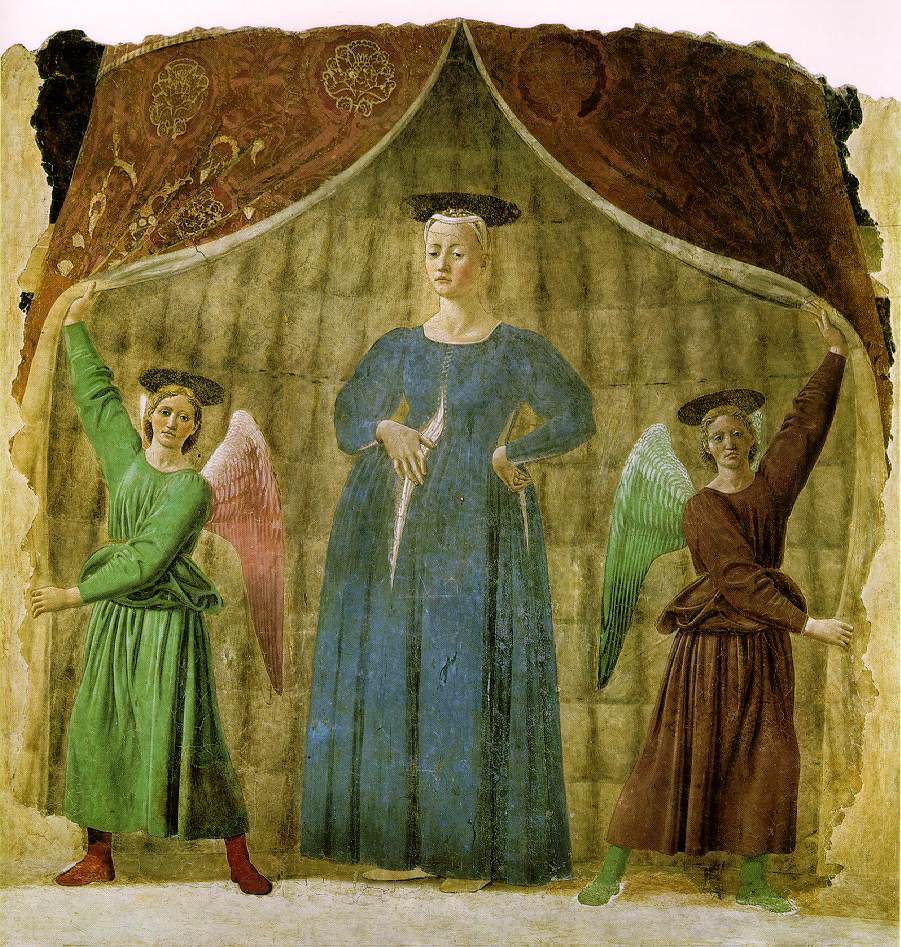
It would be wonderful to go to Italy just to follow the Piero della Francesca Trail to see this fresco.
Tuesday, March 01, 2005
Check out these ice sculptures
...by Doug Taylor. A Saskatchewan Centenary ice sculpture by Taylor, located on the grounds of the Mendel Art Gallery in Saskatoon, was recently unveiled.
Subscribe to:
Posts (Atom)